What You’ll Learn
By the end of this article, you’ll understand:
- The key differences between rigid rail and horizontal lifeline systems
- Which system performs best when fall clearance is limited
- How facility layout impacts fall protection system selection
- The advantages and limitations of each engineered fall protection solution
- Common applications for rigid rail and horizontal lifeline systems
- How OSHA and ANSI requirements influence fall protection design
- When a combination of both systems may provide the safest solution
Chocolate vs. Vanilla.
Perry Mason vs. Hamilton Burger.
Coyote vs. ACME
Such choices arouse passion, an emotion that facility managers and safety professionals cannot afford when selecting the right fall protection. Except when their passion is to safeguard their workforce.
When workers perform tasks at height—on rooftops, loading docks, production lines, and vehicle maintenance—the choice between rigid rail vs. horizontal lifeline can significantly affect worker safety, productivity, and long-term costs.
Both are effective forms of industrial fall protection and engineered fall protection systems. However, each is designed to solve a different problem. The right choice depends on available fall clearance, how much freedom of movement workers need, facility layout, and the nature of the work.
In simple terms, rigid rail systems are typically preferred when minimizing fall distance is critical, while horizontal lifeline systems are often selected for protecting workers across larger areas where mobility and coverage are priorities.
Rigid Rail Fall Protection from Top to Bottom
A rigid rail system uses a fixed overhead metal track with a trolley that travels along the rail as the worker moves. Workers connect their self-retracting lifeline (SRL) to the trolley, which glides smoothly along the track, keeping them tied off from directly above without interrupting their hands-free movement through the work area. They can be engineered for clearances as low as 4 feet.

In the event of a slip and fall, the rail stays rigid, so there is little to no deflection, thus eliminating the “pendulum effect” of a worker swaying into equipment or infrastructure. It arrests a fall quickly with minimal fall distance compared to cable-based lifelines.
Because the anchor point remains directly above the worker throughout movement, rigid rail systems help reduce swing-fall risks and improve worker confidence while performing repetitive tasks.
Overhead Rigid Rail is typically engineered for site-specific requirements and supports up to six users across spans of 6 to 100 feet.
Modular Rigid Rail uses standardized components for easy installation or reconfiguration. It can support up to four workers.
When to use rigid rail fall protection:
- Fall clearance is limited and minimizing fall distance is critical.
- Workers perform repetitive tasks concentrated in a fixed zone.
- Continuous overhead protection is needed without swing hazards.
- Cable deflection is a safety concern in the application.

Ideal applications include:
- Aircraft hangars.
- Fleet maintenance facilities.
- Manufacturing and assembly operations.
- Loading racks and tanker access.
- Elevated maintenance platforms.
- Any area with limited headroom or restricted fall clearance.
The Ins and Outs of Horizontal Lifeline Systems
A horizontal lifeline system uses a tensioned cable stretched between engineered anchor points. Workers connect to a harness using a lanyard or SRL and can then move continuously along the cable without re-clipping. This significantly reduces the human error factor compared to single-point anchors. They can support up to three workers along each 39-foot span between anchorages.
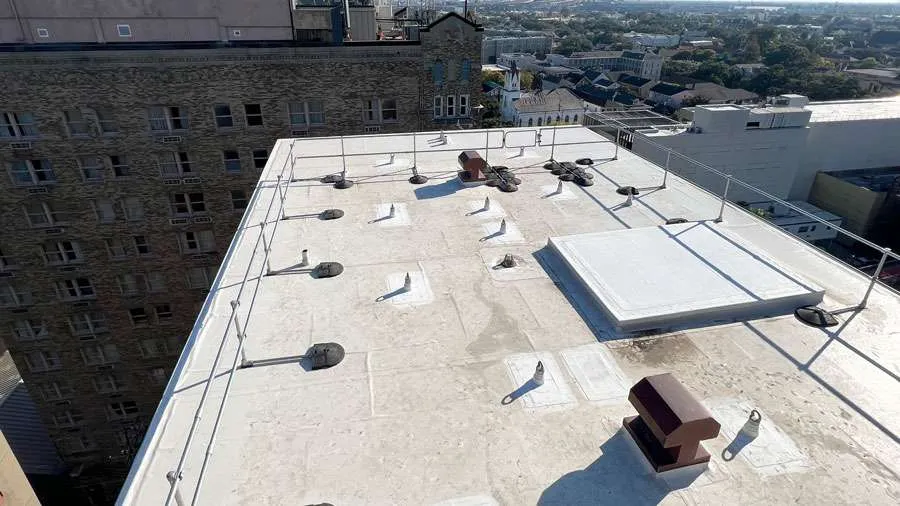
Horizontal lifelines are ideal for large, complex, or irregular work areas where a rigid track is not practical to install. They are commonly found on rooftops, structural steel, crane runways, pipe racks, utility corridors, and elevated walkways. Non-penetrating post bases are available, which help preserve roof membrane warranties.
One of the primary advantages of a horizontal lifeline system is its ability to provide continuous fall protection across long travel paths while keeping installation costs lower than some overhead systems.
Best applications for horizontal lifelines:
- Rooftops and elevated walkways where guardrails or overhead rigid rail are not practical or already in place.
- Long spans where flexibility matters more than a fixed path.
- Complex layouts spanning multiple elevations or structural configurations.
- Large facilities where economical coverage across distance is important.

Comparing Fall Clearance Requirements
The biggest difference between the two systems comes down to rigid rail fall-clearance requirements versus what a lifeline needs below it.
When a worker falls while connected to a horizontal lifeline, the cable deflects under load. That deflection adds to the total fall distance, which you must calculate below the work area.
Rigid rail systems minimize deflection, stopping a fall faster and with a shorter fall-arrest distance. This makes it the preferred overhead fall protection option when workers operate above equipment, vehicles, machinery, or other obstructions that leave little room to fall.
Rigid rail also eliminates swing hazards, since the trolley glides directly overhead rather than allowing the pendulum motion that can occur with a horizontal lifeline during a fall event. Horizontal lifelines, however, tend to cost less over long spans and adapt more easily to irregular or expansive structures.
Before selecting either system, a qualified fall protection professional should evaluate fall clearance requirements, anchorage locations, worker movement patterns, rescue considerations, and potential swing-fall hazards.
Rigid Rail vs. Horizontal Lifeline at a Glance
Rigid Rail
- Minimal system deflection
- Lower fall-clearance requirements
- Reduced swing-fall hazards
- Best for fixed work zones
- Ideal for overhead applications
Horizontal Lifeline
- Greater worker mobility across long distances
- Can protect larger areas with fewer structural components
- Typically more economical over extended spans
- Well suited for rooftop and structural applications
- Requires careful fall-clearance calculations due to cable deflection

Which System Is Right for Your Facility?
Regardless of the type of engineered system installed, it is designed to comply with OSHA 1910.140 regulations for personal fall arrest systems and ANSI/ASSP Z359 fall protection standards.
- A rigid rail system is the stronger choice when fall clearance is limited, worker activity is concentrated in a specific zone (typically work from above), and minimizing the fall distance is critical.
- A horizontal lifeline system is designed for covering long distances across rooftops, elevated walkways, or structural steel where adequate clearance already exists.
There is no universal answer because the right fall arrest system depends on your facility’s specific tasks and operational needs.
The safest and most cost-effective solution often begins with a formal hazard assessment. Understanding where employees work, how they move, and what fall risks are present allows facility managers to select a solution that balances compliance, productivity, and worker protection.
Frequently Asked Questions
What is the difference between rigid rail and horizontal lifeline systems?
A rigid rail system uses a fixed overhead track that minimizes deflection during a fall, while a horizontal lifeline uses a tensioned cable stretched between anchors that can deflect when loaded. The biggest practical difference is often the amount of fall clearance required.
Which fall protection system requires less fall clearance?
Rigid rail systems generally require less fall clearance because the rail remains rigid and experiences little to no deflection during a fall arrest event.
Are horizontal lifeline systems OSHA compliant?
Yes. When properly engineered, installed, inspected, and used according to manufacturer specifications and OSHA requirements, horizontal lifeline systems can provide OSHA-compliant fall protection.
When should a facility choose rigid rail over a horizontal lifeline?
Rigid rail is often the preferred choice when workers operate above equipment, vehicles, machinery, or other areas where available fall clearance is limited and reducing fall distance is critical.
Can a facility use both rigid rail and horizontal lifeline systems?
Yes. Many facilities use a combination of rigid rail and horizontal lifeline systems to address different hazards and work areas throughout the facility.
Who should design a fall protection system?
Engineered fall protection systems should be designed and evaluated by qualified professionals who understand OSHA regulations, ANSI standards, fall-clearance requirements, anchorage loads, and site-specific hazards.
See Us for Your Safety Solutions
There is nothing wrong with preferring chocolate shakes, but then vanilla ice cream in your sundae. Would Perry Mason be such a renowned defense attorney without a formidable District Attorney like Ham Burger in opposition? Wile E. Coyote and ACME once enjoyed a long-standing business relationship.
In practice, many facilities use rigid rail for overhead work where clearance is tight, and horizontal lifeline for the open spans where mobility matters more.
Both are valuable components of a comprehensive engineered fall protection system, and both should be installed and inspected in line with applicable OSHA and ANSI standards. A qualified safety partner can conduct a hazard assessment and engineered design review to determine which approach, or combination of systems, provides the safest, most effective protection for your workforce.
Every facility presents unique fall hazards, which is why engineered fall protection systems should never be selected based solely on cost or convenience. A professional site assessment can help identify risks, verify compliance requirements, and ensure workers have reliable protection whenever they are exposed to fall hazards.
If you are responsible for worker safety at your facility, contact Lighthouse Safety for compliant solutions. We will discuss your regulatory concerns and what it will take to comply. Our services encompass everything you need, from design, engineering, and fabrication to installation, training, inspections, and other support.